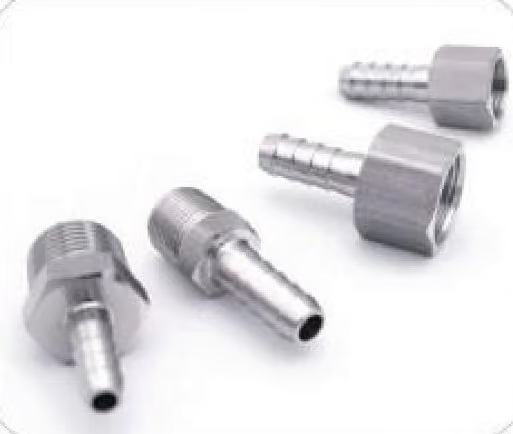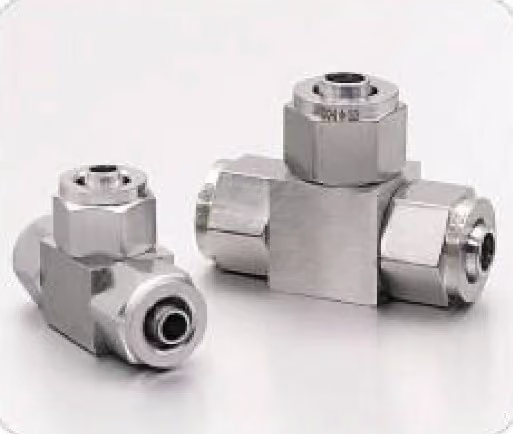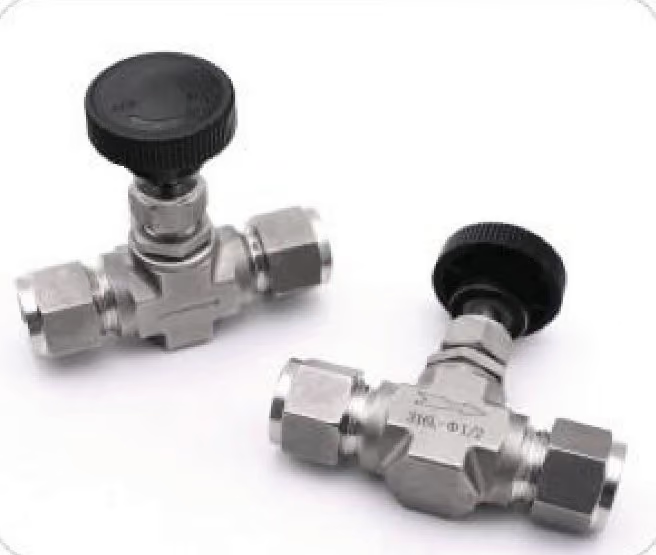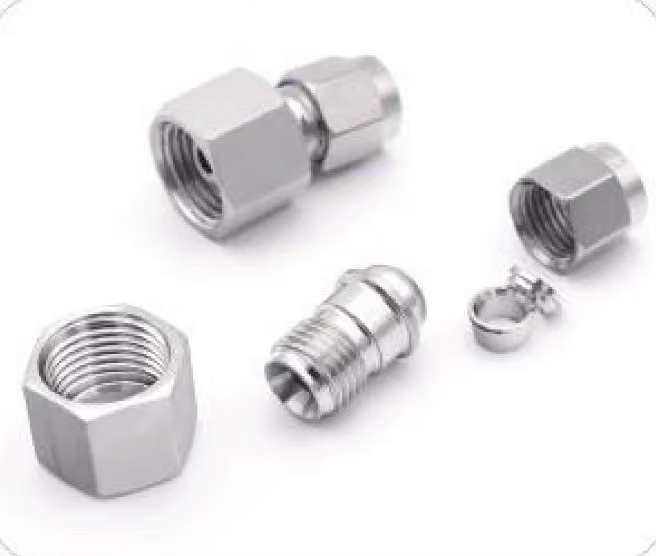
Electropolishing and passivation both improve the corrosion resistance of stainless steel, and they are routinely lumped together on RFQs — but they do different jobs. Passivation is a chemical treatment that removes free iron and restores the chromium oxide film without removing measurable material. Electropolishing is an electrochemical process that dissolves the surface itself, smoothing microscopic peaks, lowering the Ra, and leaving the part brighter and passivated in the same step. Choosing between them is a question of what the surface must do, and paying for electropolishing when passivation suffices is money spent on nothing the spec asked for.
Key takeaways
- Passivation changes surface chemistry, not shape: no measurable material removal, no roughness change, tight tolerances survive it — that is the passivation story in depth in passivation of stainless steel fittings.
- Electropolishing removes material — ASTM B912 cites roughly 5–10 µm as typical, more when specified — so it smooths, brightens, micro-deburrs and passivates in one step, and needs a stock allowance on critical fits.
- There is no universal Ra outcome for EP: sources cite typical finished ranges around 4–16 µin, with low single digits as a UHP target class — specify the Ra, measurement method and locations, never just “electropolished.”
- Pay for EP when the spec demands a smooth, cleanable, low-Ra or particle-sensitive surface — sanitary, pharmaceutical and semiconductor duty — and for passivation when the requirement is clean, passive chemistry at the lowest cost.
What each process actually does
Passivation immerses the part in an oxidizing acid — nitric or citric — that dissolves free iron and contamination while leaving the base alloy alone, so the chromium oxide film reforms on a clean surface. Nothing measurable comes off the part, the Ra stays where machining left it, and the dimensions are unchanged. That makes it the default treatment for machined fittings, valve bodies and hardware: cheap, fast, dimensionally neutral, and sufficient wherever the requirement is baseline corrosion resistance.
Electropolishing makes the part the anode in an electrolyte — phosphoric-sulfuric acid is common — and the applied current dissolves surface metal, fast at the microscopic high points and slower in the valleys. What leaves the tank is measurably smaller, measurably smoother and brighter, with micro-burrs, embedded contaminants and light heat tint removed, and a chromium-enriched surface that passivates as it forms. ASTM B912, which covers passivation by electropolishing, cites typical removal of about 5–10 µm per surface with more possible when specified — which is exactly why close fits, threads and bores need the removal planned into the stock allowance, not discovered at final inspection.
The Ra outcome, honestly stated
Because EP removes peaks, it lowers Ra — but there is no guaranteed number. The honest range across sources is wide: published EP outcomes span roughly 4–16 µin as typical, with general industrial targets in the teens and low single digits as an ultra-high-purity target class. The result depends on the starting finish, alloy, geometry and process control. So the buying rule is: state the required Ra, the measurement method and where it is measured, plus the starting condition. “Electropolished” alone is not a roughness specification. Our printable Ra surface finish chart lays the bands side by side — mill finish, grit-polished and electropolished — with the ASME BPE surface-finish designations for sanitary work.
When the spec demands which
Match the treatment to the requirement, not to the industry label. Where the duty is baseline corrosion protection on dimensionally precise machined parts, passivation is the right and sufficient spend. Where the surface must be smooth to clean, resistant to particle adhesion, or hit a stated low Ra — hygienic product contact, pharmaceutical distribution systems, high-purity and semiconductor gas paths — electropolishing does work passivation cannot, and the spec will usually say so in Ra terms or reference BPE-style designations. Where weld heat tint or scale is present, neither is the primary fix: pickling comes first, then passivation or EP — the three-way split is covered in passivation of stainless steel fittings. Sanitary design context, including where 3-A and ASME BPE apply, lives in sanitary stainless fittings.
The cost and scope reality
Passivation runs in bulk baskets with minimal fixturing, so it is the lower-cost, faster treatment almost every time. Electropolishing adds custom racking, current-density control per part position, bath maintenance and management of metal removal — cost scales with geometry rather than just area, and published premium figures are shop rules of thumb rather than a benchmark. On tight-tolerance parts, the dimensional allowance is a real engineering cost: removal must be designed in. The ordering document should state the maximum stock removal and the final dimensions, which is exactly what ASTM B912 asks of it.
Name the treatment with the requirements on the RFQ: passivate per ASTM A967, or electropolish per ASTM B912 with a stated Ra, removal limit and measurement points. We quote either with the fittings and tube on the same line. Request a factory quote.
FAQ
What is the difference between electropolishing and passivation? Passivation is a chemical treatment that removes free iron so the chromium oxide film reforms — no measurable material removal, no roughness change. Electropolishing is electrochemical: it dissolves surface metal, smoothing and brightening while passivating, typically removing about 5–10 µm per surface.
Does electropolishing remove material? Yes — that is the point. Typical removal is around 5–10 µm per surface per ASTM B912, more when specified. Plan a stock allowance on threads, bores and close fits so finished dimensions stay in tolerance.
What Ra can electropolishing achieve? There is no universal outcome. Published typical results span roughly 4–16 µin depending on starting finish, alloy and control, with low single digits as a UHP target class. Specify the required Ra, measurement method and locations rather than relying on the word “electropolished.”
Can passivation change the surface roughness? No. Passivation changes surface chemistry — it removes free iron and restores the passive film — but it does not measurably remove material or alter Ra. If the spec needs a smoother surface, that is electropolishing or mechanical polishing territory.
When should I specify electropolishing instead of passivation? When the surface must be smooth to clean, low in particle adhesion, or meet a stated low Ra — sanitary, pharmaceutical and high-purity semiconductor duty are the classic cases. For baseline corrosion protection on precise machined parts, passivation is sufficient and cheaper.
What does ASME BPE actually require for electropolished surfaces? ASME BPE — the bioprocessing equipment standard — handles surfaces in Part SF with seven product-contact designations, SF0 through SF6, each binding a maximum Ra and a finishing route at once: SF1–SF3 are the mechanically polished ceilings of 20, 25 and 30 µin (0.51, 0.64, 0.76 µm), SF4–SF6 the electropolished ceilings of 15, 20 and 25 µin (0.38, 0.51, 0.64 µm), with SF4 the usual pharmaceutical product-contact callout. The Ra values are maximums, not averages, and an electropolished surface is not automatically SF4: it holds whichever designation its measured Ra actually meets. Passivation still applies alongside — chemical passivation per ASTM A967 / AMS 2700 commonly follows EP to chromium-enrich the passive layer — so both treatments can appear in one BPE spec. On the RFQ, cite the designation, not the word “electropolished”; the designation is the Ra-plus-method statement this page keeps asking for.