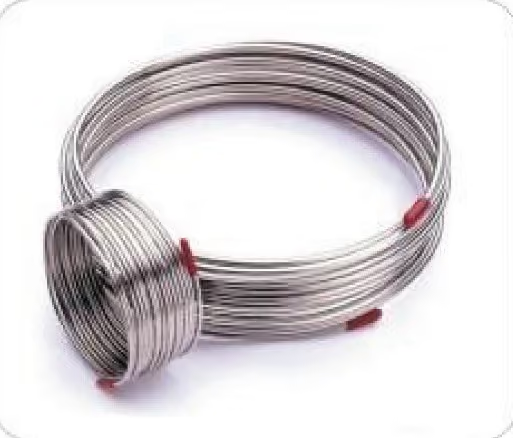
Stainless steel coil tubing is the same instrument tube as the straight sticks, wound continuous onto a reel instead of cut to random lengths — and that one change deletes most of the fittings from a long run. Every coupling you don’t install is a leak point you never have to inspect, tighten or replace. A 600 ft instrument run assembled from 20 ft straight lengths needs 30 sticks and 29 couplings; from a single coil it needs one line and no couplings at all. Stock coils commonly run 50–1,000 ft, and mill coils reach several thousand feet.
Key takeaways
- Joint math drives the choice: couplings needed = run length ÷ straight-stick length − 1. A 600 ft run in 20 ft sticks is 29 couplings; one coil is zero.
- Order instrument coil tubing to ASTM A269 — seamless or welded austenitic tubing for general service, furnished straight-cut or in coil. Stock grades are TP304/TP316/TP316L; 316/316L for chloride-bearing duty, 304 for clean air and water.
- 316L is the welded-joint-safe version of 316: carbon capped at 0.03% versus 0.08%, which prevents carbide precipitation (sensitization) in the weld heat-affected zone.
- Coils ship fully annealed. Field work is unroll, cut square, deburr, clean — published installation procedures run exactly those steps, with no re-annealing step.
- A269 requires each tube to pass a hydrostatic test or a nondestructive electric (eddy-current) test — write which one you want on the RFQ.
Coil vs straight lengths
The comparison is mostly arithmetic. Instrument runs of a few hundred feet are routine — analyzer shelters, impulse lines to distant transmitters, refrigeration-style instrument jumps — and every straight-length assembly carries one coupling per stick junction, plus the labor of cutting, deburring and fitting each one. The leak-point count is simply:
joints = run length ÷ straight length − 1
| Run length | 20 ft sticks (couplings) | 6 m sticks (couplings) | One continuous coil |
|---|---|---|---|
| 100 ft | 4 | 4 | 0 |
| 300 ft | 14 | 15 | 0 |
| 600 ft | 29 | 31 | 0 |
| 1,000 ft | 49 | 51 | 0 |
Each joint is also a potential trap for corrosion product, and each one takes time on the hook-up schedule. Straight lengths still win for short drops and panel work — coil is the tool for the long, uninterrupted runs.
Sizes and grades
For impulse and analyzer duty, the core coil range runs 1/8 to 1/2 in OD (3–12 mm) with walls of 0.028–0.065 in — the sizes that carry instrument signals, not process flow. Maker catalogs extend to roughly 1/16 in–1 in OD, so treat 1/8–1/2 in as the typical instrument range, not a limit. Wall choice sets the pressure rating; the same OD in 0.035 in and 0.065 in wall is two very different tubes.
On the specification line, instrument coil tubing is normally ordered to ASTM A269, the specification for seamless and welded austenitic stainless steel tubing for general service, which explicitly covers tubing furnished in coil. Grades and where they fit:
- TP316 / TP316L — the default for corrosive or chloride-bearing duty. The molybdenum-bearing grade resists pitting that 304 cannot.
- TP304 — the honest value on clean, dry instrument air and water at moderate pressure. It costs less and corrodes no faster than 316 where there are no chlorides.
- 316L over 316 wherever the tube will be welded: the L caps carbon at 0.03% (against 0.08% for straight 316), preventing chromium-carbide precipitation at the weld heat-affected zone — sensitization that would leave a corrosion-prone seam.
For high-purity or corrosion-critical service the inside surface matters as much as the grade; that is the bright-annealed territory covered in bright annealed tubing for instrumentation.
How it ships and installs
Coil arrives as a wound reel or bound coil with the ends capped — keep those caps on in storage, because an open coil end invites moisture staining down the ID before the first cut. On site:
- Unroll, don’t pull. Pulling the free end out sideways twists and work-hardens the tube. Walk the coil off the reel so it feeds straight.
- Let it straighten. Coil set relaxes once the tube is unrolled; fight kinks with a proper tube bender, not force — the bending discipline is the same as for straight tube, covered in how to bend stainless steel tubing without kinking.
- Cut square, deburr, clean. Use a tube cutter that doesn’t deform the tube, deburr inside and outside edges so the tube seats cleanly in the ferrule, and wipe the ID before assembly. Published installation procedures run exactly these steps — cut, deburr, clean — with no re-annealing step: instrument coil is supplied fully annealed, soft enough for bending and flaring, so a clean square cut is ready to fit.
One honesty note: coil “memory” is real on short bends. If a kink forms, the tube is scrap — cut it out and remake the section rather than forcing it straight.
What to write on the RFQ
A quotable coil RFQ has seven lines:
| Line | Write | Why it matters |
|---|---|---|
| OD and wall | 1/4 in OD × 0.035 in wall |
Sets flow and pressure rating |
| Grade and spec | ASTM A269 TP316L |
Grade alone invites substitution |
| Total length | 600 ft |
The run total |
| Max length per coil | max 500 ft per coil |
Reel weight and freight width; mill coils can run far longer |
| Test method | hydrostatic test or eddy current NDE |
A269 accepts either — say which |
| Condition | fully annealed, ends square-cut, deburred, capped |
Arrives ready to install |
| Standard | ASTM A269 (not A213 unless boiler/high-temp) |
A213 is the boiler-service sibling spec |
FerruleX quotes stainless coil tube in 304/316/316L by OD, wall and coil length — see the instrumentation tubing range and the stainless steel coil tube line, and send the seven lines above for a factory quote. Request a factory quote.
FAQ
Can coil tubing be cut on site? Yes — that is the point. Walk the run, measure off the reel, cut square with a proper tube cutter, deburr the inside and outside edges, and clean the ID before assembly. The cut end is ready for a compression fitting as-is; published installation procedures list cut, deburr and clean, with no re-annealing step.
What length does a coil come in? Stock coils commonly run 50–1,000 ft, with 100, 250 and 500 ft the most frequently stocked increments; continuous mill coils reach several thousand feet. State both the total length you need and the maximum length per coil on the RFQ, because reel weight and shipping width limit what travels.
316 vs 316L for coil tubing — which one? Same corrosion behavior; the difference is carbon. Straight 316 allows up to 0.08% carbon, 316L caps it at 0.03% — the lower carbon prevents carbide precipitation at welded joints, so pick 316L where tube stubs will be welded, and either grade where the run is compression-fittings only. Where chlorides are present, pick 316-family over 304 regardless.
What pressure can coil tubing take? OD, wall and temperature set it. Published working-pressure tables use Barlow’s formula with a burst-to-working factor that is commonly 4:1 (some makers publish 3.75:1), while code-rated designs follow ASME B31.3 allowable stress. Send OD, wall, grade and service conditions and have the factory confirm the rating.
What specification covers coil tubing? ASTM A269 — seamless and welded austenitic stainless steel tubing for general service, furnished straight or in coil — is the standard instrument-tubing specification, covering TP304/TP304L/TP316/TP316L. ASTM A213 is the sibling specification for boiler and high-temperature service; unless the run sees boiler conditions, A269 is the line to write.