Chloride stress corrosion cracking is the failure mode that takes down 316 stainless without rust, without warning and without forgiveness. A fitting that passes PMI, passes hydrotest and looks perfect can part along a crack that grew in weeks — because cracking needs no visible corrosion to proceed. It needs three things: chlorides, tensile stress and temperature. The buyer’s defense is knowing the threshold band, knowing what 316L does not fix, and writing the environment on the RFQ so the alloy decision is made before the first failure instead of after.
Key takeaways
- Chloride SCC of austenitics is transgranular — the crack runs through the grains, not along them, and propagates fast once started.
- Engineering guidance puts the risk zone at roughly 50–60 °C and up when chlorides and tensile stress coexist; above about 100 °C, ppm-level chlorides are enough.
- The stress can be residual — an untreated weld’s residual stress alone can exceed the threshold.
- 316L buys nothing here: lower carbon fixes weld sensitization, a different failure; chloride SCC tracks nickel content.
- The upgrade ladder: duplex 2205 for moderate chloride heat, nickel alloys for the hot chloride frontier, copper alloys where ammonia is absent — plus stress relief, drainage and washing as design-level defenses.
The mechanism
Three conditions must coincide, and all three are common. Chlorides — from seawater, brackish water, chloride-bearing steam, insulation leachate or condensed chlorinated atmospheres. Tensile stress — applied system pressure, or simply the residual stress locked around a weld that was never heat-treated; mill data warns that untreated weld residual stress alone can approach the material’s proof strength. Temperature — the accelerator. Where pitting is visible and slow, chloride SCC is invisible and fast: the crack path is transgranular, running through grains under the combined chemical-mechanical attack, and it can penetrate a wall before any surface sign appears. The most famous demonstration is the 1985 Uster swimming-pool roof collapse — stainless tension rods cracked by chloride SCC in a warm, chlorinated atmosphere at temperatures well below the classic thresholds.
The threshold chart
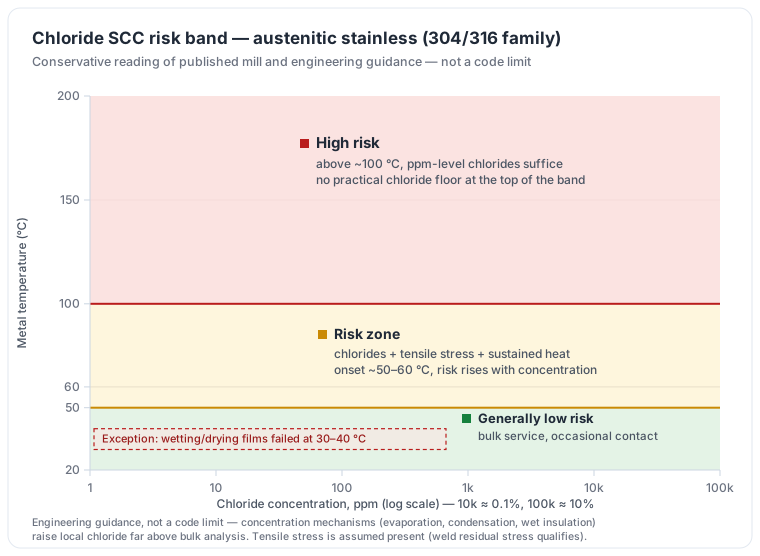
No single number exists — the published guidance is a band, and the honest way to draw it is conservative:
| Region | Engineering guidance | Source pattern |
|---|---|---|
| Below ~50 °C | Generally low risk for 304/316 in occasional chloride contact — but repeated wetting-drying films have failed at 30–40 °C | mill datasheets; documented pool-hall cases |
| ~50–60 °C and up | Risk zone begins: chlorides + tensile stress + sustained temperature | Alleima, Outokumpu, EEMUA 194 guidance |
| Above ~100 °C | Chlorides in the ppm range suffice | mill datasheet wording, verbatim |
Treat this table as engineering guidance, not code — the industry rules themselves say the limit is subject to debate, and concentration mechanisms are the wild card: evaporation, condensation and insulation-leached chlorides concentrate locally far above the bulk chemistry. Corrosion-under-insulation references put the susceptible skin-temperature window for austenitics under wet insulation at roughly 50–175 °C, which is exactly where a lot of outdoor 316 pipe lives.
The same band as a picture — the conservative zones, with the wetting-drying exception sitting below the line and no practical chloride floor at the top:
Where it bites
Coastal and marine atmospheres — salt aerosol on warm equipment. Seawater and brackish service. Chloride-bearing steam and condensate. Insulated lines where moisture wicks chlorides against the metal: CUI. And building services — the pool-hall cases showed 316 ducting and supports cracking at 30–40 °C under chloramine-laden condensation. The through-line is concentration: any geometry that lets a thin chloride film sit and dry repeatedly is a candidate, whatever the bulk analysis says.
Material answers
316L is not an answer. The L grade caps carbon at 0.03% to stop weld-zone carbide precipitation — intergranular corrosion, a different failure. Chloride SCC tracks nickel: austenitics at 8–12% Ni sit in the vulnerable band, and mill guidance puts good practical resistance at about 25% nickel. Alloy 20 and 904L earn their keep here. Duplex 2205 resists markedly better than 316 — higher strength and a mixed microstructure raise the threshold — but “more resistant” is not immune; duplex has its own limits in hot concentrated chlorides. Nickel alloys such as 625 are effectively immune in practical chloride service, at a price that reserves them for the frontier — which is why the upgrade decision belongs on the RFQ with the environment stated, not as a blanket surcharge on every line the way oversized valves waste money in valve sizing gone wrong. Copper alloys ignore chloride SCC entirely — but brasses crack in ammonia, so the exemption has a catch. And the free defenses: stress-relieve or shot-peen where possible, design crevices and dead pockets out, keep surfaces washed, and never let insulation sit wet on hot stainless. The pitting side of chloride behavior — the initiation site for many cracks — is covered in pitting corrosion in stainless steel fittings, and the weld-zone half of the story in passivation of stainless steel fittings.
RFQ lines
media and chloride content— bulk ppm, plus any concentration mechanism known.temperature band— normal and upset, metal temperature not just fluid.welded construction?— HAZ residual stress is the default stress source.environment— coastal, insulated, pool-adjacent, steam-adjacent: words that change the alloy shortlist.
FAQ
Does 316L resist SCC better than 316?
Essentially no. The L grade’s lower carbon prevents weld sensitization — intergranular corrosion at the heat-affected zone — which is a different failure mechanism. Chloride stress corrosion cracking tracks nickel content, not carbon, so 316 and 316L sit in the same vulnerability band. If chlorides and temperature are the threat, the upgrade runs through duplex or nickel alloys, not the L suffix.
At what temperature does chloride SCC start in 316?
Published engineering guidance puts the general risk onset at roughly 50–60 °C when chlorides and tensile stress coexist, with risk rising steeply above that and ppm-level chlorides sufficing above about 100 °C. The honest caveat: concentrated, repeatedly-wetting chloride films — condensation, evaporation, insulation leachate — have produced failures at 30–40 °C, and the industry rules call the limit debatable. Treat 50 °C as the line where the conversation starts, not where safety ends.
Is duplex stainless immune to chloride SCC?
No — and write that down before someone specs it as one. Duplex 2205 is markedly more resistant than 316 because of its mixed microstructure and higher strength, and it extends the service window substantially. But duplex still has limits in hot, concentrated chlorides, and corrosion references say so plainly. For genuinely hostile chloride heat, the answer is a nickel alloy.
How do I know if my application is at risk?
Three questions: chlorides present in the medium or the environment (including insulation and atmosphere)? Sustained metal temperature above ~50 °C, or a concentration mechanism that dries films on the metal? Tensile stress — which, with welded construction, you already have? Two of three demand attention; all three demand an alloy conversation. Put the numbers on the RFQ and let the material answer follow.
What is the difference between chloride SCC and pitting?
Pitting is localized surface attack — visible, driven by chloride breakdown of the passive film, measured by PREN. Chloride SCC is cracking driven by chlorides plus tensile stress plus temperature, propagating through the metal with little or no visible corrosion. In practice they are cousins: pits and crevices often act as initiation sites for cracks. PREN tells you about pitting, not SCC — that is why this post exists.