316 and 316L stainless steel are the same molybdenum-bearing austenitic grade with one compositional difference: 316 allows up to 0.08% carbon while 316L caps carbon at 0.03%. Everything else — chromium, nickel, the 2–3% molybdenum, and the corrosion resistance of the unwelded metal — is the same. The entire buying question is what that carbon difference does at the weld, and this post is about that decision: when either grade serves, and when the L is not optional.
Key takeaways
- The only compositional difference is carbon: ASTM A240 limits 316 to 0.08% C max and 316L to 0.03% C max; molybdenum, chromium and nickel ranges are identical, so unwelded corrosion resistance is essentially the same.
- The L exists because of weld sensitization: in the roughly 450–850 °C range, carbon forms chromium carbides at grain boundaries and leaves chromium-depleted zones that corrode — 316L’s low carbon keeps carbide formation negligible.
- 316L is the default wherever welds stay as-welded in corrosive service: thin-wall tubing, sanitary and pharmaceutical systems, fabricated manifolds — 316 with post-weld annealing can match it, but annealing is rarely practical.
- Much stock is dual-certified to both grades; where it is not, the L premium is small — state 316L explicitly on welded lines rather than accepting “316” as close enough.
Same grade, different carbon
Both grades sit in the same ASTM A240 family with identical chromium, nickel and molybdenum ranges — the chemistry difference is carbon alone, at 0.08% maximum for 316 and 0.03% maximum for 316L. In service, as-welded surfaces aside, their corrosion resistance is essentially identical, which is why mill stock is often dual-certified to both. The practical differences are mechanical and thermal: standard 316 carries slightly higher minimum strength values and better elevated-temperature creep behavior, which is why high-temperature, non-welded components sometimes still specify it. For the fittings and tubing this catalog serves, those mechanical differences almost never decide the question. The corrosion side of the grade family — why 316 over 304 at all — stays covered in SS304 vs SS316 and is not re-treaded here.
The sensitization mechanism
When 316 is welded, the heat-affected zone passes through roughly the 450–850 °C band where carbon is mobile but chromium diffusion is slow. Carbon combines with chromium at the grain boundaries, precipitating chromium carbides and leaving a narrow zone next to each boundary depleted of chromium — below the level needed to maintain the passive film. In corrosive service that depleted network corrodes preferentially: intergranular attack that looks like rust lines along welds, and on chloride service, weld-adjacent pitting. The fix is either to remove the carbon (316L — carbide formation is negligible at 0.03%) or to dissolve the carbides after welding by solution annealing and rapid cooling — effective on heavy sections, but rarely practical for thin-wall tube, sanitary spools, or shop-fabricated manifolds. Sensitization is reduced risk, not zero risk: a 316L weld in warm concentrated chlorides still wants the right environment and post-weld cleaning, and the passivation-versus-pickling question after welding is covered in passivation of stainless steel.
Which one for which duty
| Aspect | 316 | 316L |
|---|---|---|
| Carbon max (ASTM A240) | 0.08% | 0.03% |
| Molybdenum | 2–3% | 2–3% |
| Corrosion resistance, unwelded | Same | Same |
| Weld behavior | Sensitizes in the HAZ unless post-weld annealed | Safe as-welded; no anneal needed |
| Typical use | Machined, non-welded parts; high-temperature service | Welded tubing and manifolds; pharma; sanitary; chloride service with welds |
| When to pay for L | Skip only when nothing is welded and service is mild | Mandatory where welds stay as-welded in corrosive service |
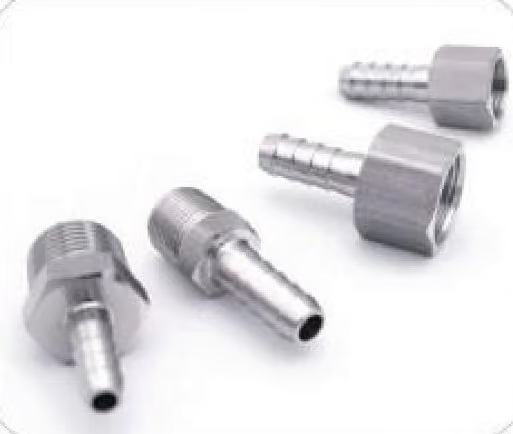
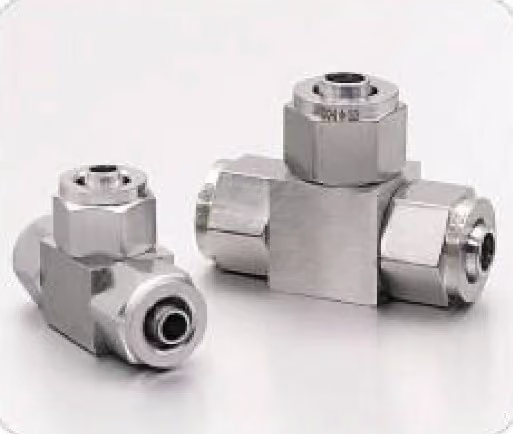
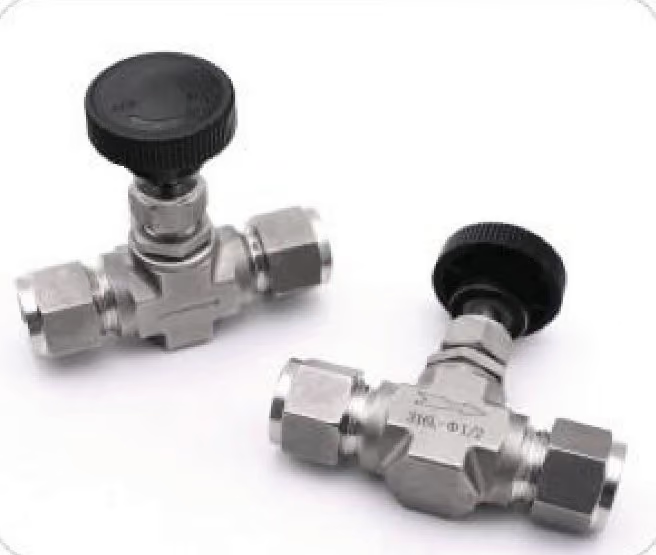
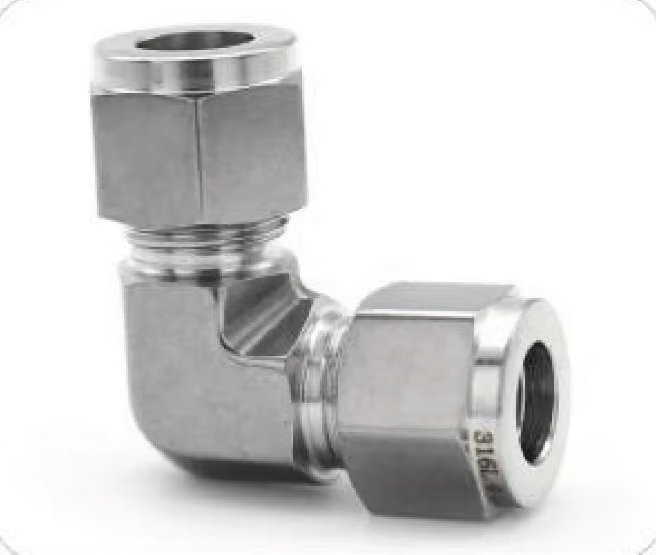
For fittings specifically, the split is practical. Machined compression bodies, nuts, ferrules and valve bodies that join by ferrule or thread — no weld, no sensitization, 316 serves. Anything welded in service: welded tube systems, fabricated manifolds, sanitary spools with ferrule ends, instrument tubing runs joined by orbital welds — that is 316L territory, and it is why pharmaceutical and biotech specifications default to the L grade across the board. The pharma context is mapped on the pharmaceutical page, and the tube-side surface logic in bright annealed tubing.
Stating it on the RFQ
Three habits keep the grade question clean. First, say 316L per line for anything welded — “316” on a welded line is an invitation for a substitution you did not want. Second, accept dual-certified stock where it exists: it satisfies both grades and removes the premium question. Third, when certificates matter, ask for the heat analysis so the carbon value is on paper, not assumed. FerruleX quotes 316 and 316L across instrumentation tubing, compression fittings and valves; name the grade per line and welded assemblies arrive in 316L with the mill documentation to match. The full grade table with composition and PREN lives on our stainless steel grades chart sheet. Request a factory quote.
FAQ
What is the difference between 316 and 316L stainless steel? Carbon content. Under ASTM A240, 316 allows up to 0.08% carbon and 316L caps it at 0.03%; chromium, nickel and molybdenum ranges are identical. Unwelded corrosion resistance is essentially the same — the L grade exists to protect welded joints.
Is 316L more corrosion resistant than 316? In the base metal, no — same alloy, same resistance. The difference appears after welding: 316’s heat-affected zone can sensitize and corrode intergranularly where 316L stays sound as-welded. In a chloride line with welds, that makes 316L effectively the more corrosion-resistant choice.
When is 316L mandatory? Wherever welds remain as-welded in corrosive service and post-weld annealing is impractical: thin-wall tubing systems, sanitary and pharmaceutical fabrications, welded manifolds and panels. Project specs, codes and service conditions make the final call, but welded chloride service is the standing case for the L.
Can I use 316 for welded tubing if I passivate it? Passivation restores the surface film but does not undo sensitization, which is a subsurface chromium-depletion problem along the weld. Pickling plus passivation improves a sensitized weld cosmetically and marginally, but the structural answer is 316L — or post-weld solution annealing, which is rarely practical for tubing.
Does 316L cost more than 316? Often a small premium where single-grade stock is quoted, though much bar and tube stock is dual-certified to both grades at one price. For welded work the difference is minor against the cost of a sensitization failure; state 316L on the RFQ and let the quote reflect the actual stock.