Stainless Steel Fittings & Valves for Water & Wastewater Treatment
Chlorides decide the grade on water duty. Tell us the source water, the dosing chemistry and whether any line sees full seawater, and the quote comes back in the right stainless instead of a grade that pits in service.
Why water treatment needs stainless
Source water, reclaimed wastewater and desalination streams all carry chlorides, and chlorides are what pit stainless steel. SS304 serves clean, low-chloride water, but the dosing chemistry — hypochlorite, acids, caustic — and coastal or brackish source water push selection to SS316, whose molybdenum content improves pitting resistance. One honest limit: continuously wetted seawater and hot brine service is duplex stainless territory, not 316, and we say so rather than quote a grade that will pit. The grade split is the same one covered inSS304 vs SS316 — the water industry simply lives on the chloride-driven side of it.
Typical duties on a water line
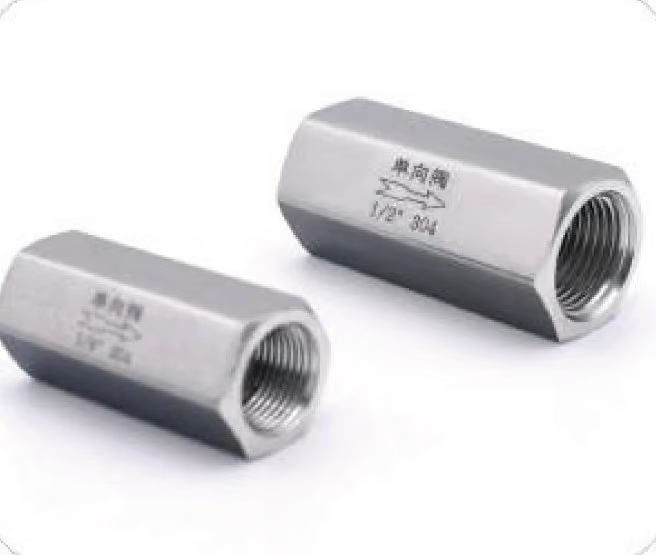
The stainless content of a treatment plant sits in the dosing and instrumentation, not the main pipework: chemical dosing lines for disinfection, coagulation and pH control; check valves on dosing pump outlets so the chemical does not back-flow into the pump; analyzer sample lines for pH, chlorine and turbidity; instrument air and pneumatic panels; and flexible connections on vibrating pump skids. The check-valve duty matters most — a stuck or leaking dosing check valve doses the wrong amount or lets the chemical eat the pump — which is why that family gets its own guide in types of stainless check valves.
Duty to product family
| Duty | Recommended FerruleX family | Grade / note |
|---|---|---|
| Dosing pump outlet, one-way flow | Check valves (female check valve) | SS316 where compatible — state the dosing chemical, some chemistry pushes beyond stainless |
| Dosing line metering and isolation | Needle valves | SS316; throttle the dose at the sample point |
| Chemical injection tube runs | Compression fittings + instrumentation tube | SS316; state the chemical and concentration |
| Analyzer sample lines | Precision / BA tube | SS316; smooth bore for clean samples |
| Process isolation on skids | Ball valves | SS316 bodies for chloride service |
| Pump and blower vibration connections | Corrugated hose assemblies | SS316 where the stream is chlorinated |
| Mixed-thread dosing manifolds | Adapters and weld fittings | SS316; identify NPT versus G before ordering |
Standards context
Compression joints follow ISO 8434-1 / DIN 2353 practice — the 24° cone system from bite-type fittings explained — and tubing follows ASTM A269 conventions frombright annealed tubing. Water and wastewater duty is industrial, non-sanitary service: no hygienic standard applies, and fully wetted seawater or hot brine lines belong to duplex grades outside this catalog — state the exposure and we will tell you plainly when 316 is not the right answer.
What to state on the RFQ for water duty
- Source water type — municipal, reclaimed, brackish or seawater — and the chloride level where known.
- Whether any line is continuously wetted by seawater or brine, so duplex can be flagged honestly instead of over- or under-specifying.
- Dosing chemical and concentration per line — hypochlorite, acid, caustic or coagulant.
- Design pressure and temperature per line.
- Grade call-out (SS316 / SS316L) and thread standard per line.
Ready to order from the factory?