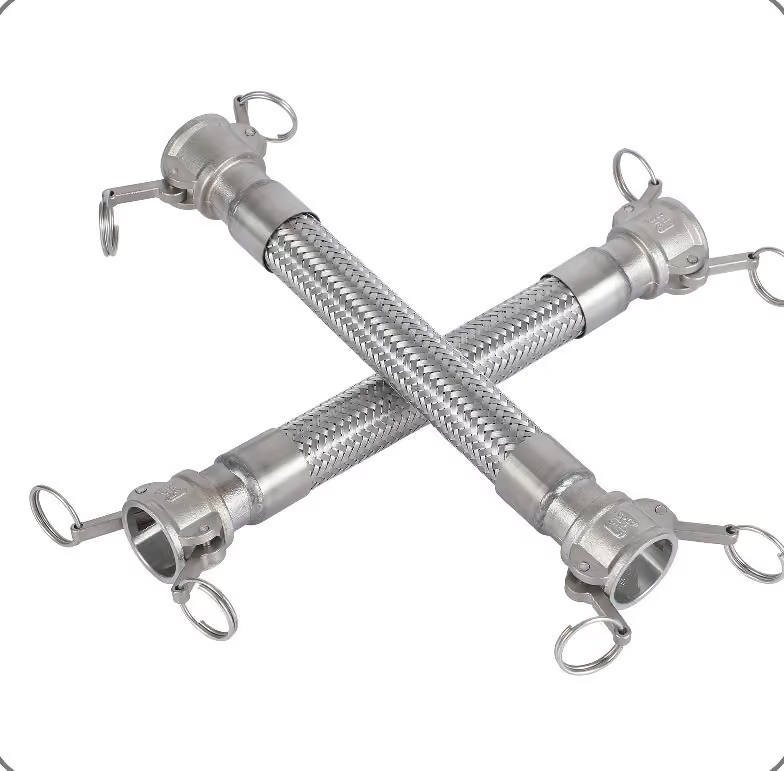
There is no honest single number for stainless steel hose life: the same assembly can run for decades in a static, indoor, clean service and fail within months in a vibrating, hot, chloride-wet one. What we can give you is the failure scorecard — what actually kills hoses, how fast each killer works, and the handling rules that separate the decades-long installations from the callbacks.
Key takeaways
- Hose life is set by duty, not calendar: static, well-supported installations last decades, while repeated flexing, vibration and thermal cycling consume the corrugations’ fatigue life — sometimes in months.
- The four killers are flex fatigue from movement, bend-radius abuse that work-hardens corrugation roots, chloride attack on the alloy, and internal erosion from excessive velocity — with overpressure arriving as the fifth, usually self-inflicted.
- Inspection is visual and cheap: flattened or discolored corrugations, cracked braid wires, weeping weld collars or movement toward the minimum bend radius are the replace-it-now signals.
What actually kills stainless hose
Flex fatigue is the number-one consumer of hose life. Every movement cycle — thermal growth, vibration, pump pulsation — opens and closes the corrugations, and each corrugation has a finite cycle count. The corrugation roots see the highest stress and crack first: one ring flattens, then splits circumferentially, and the assembly weeps or bursts. Fatigue life scales with how tightly the hose is bent and how far it must flex, which is why live length and bend radius dominate the calculation.
Bend-radius abuse accelerates everything. A hose held below its minimum bend radius takes a permanent set; in dynamic service the roots work-harden and the fatigue cracks arrive orders of magnitude sooner. This is the most common installation error and the easiest to prevent.
Chlorides attack the alloy, not the geometry. In warm, stagnant, chloride-bearing service — coastal air, splash zones, some cleaning chemicals — 304 pits and stress-corroses; 316 buys margin, not immunity. Match the alloy to the environment as we detail in SS304 vs SS316, and drain or shield hoses that sit wet between cycles.
Velocity and erosion wear the corrugations from the inside. Corrugated hose already flows measurably worse than smooth pipe; push a high-velocity stream — especially with entrained particles — through it and the peaks erode, thinning the wall that fatigue then finishes.
Overpressure is the self-inflicted killer: surge, water hammer, blocked outlets. Pressure ratings are cold and steady-state; surges belong outside them.
The failure scorecard
| Failure mode | How it kills the hose | Prevention |
|---|---|---|
| Flex fatigue | Corrugation roots crack circumferentially after cycles | Generous live length and bend radius |
| Bend-radius abuse | Permanent set, then work-hardened roots and early cracks | Stay above static and dynamic minimum radii |
| Chlorides | Pitting and stress corrosion in wet, warm service | 316 alloy, drainage, shielding from splash |
| Velocity erosion | Corrugation peaks thin from the inside | Size for moderate velocity and ΔP |
| Overpressure | Surge and hammer load the wall beyond its rating | Slow valve actuation, surge arrest |
Duty classes: why some hoses last decades and others months
A hose that is installed straight, supported, indoors and left alone barely ages — static service consumes almost nothing but time. Add thermal cycling and the calendar starts to matter; add vibration or continuous movement and the failure mode shifts to fatigue with a life measured in cycles, not years. That is why identical assemblies can have opposite fates, and why an honest specification includes movement and cycle duty, not just pressure class. For anything that flexes repeatedly, demand the dynamic bend radius and a live length sized for the movement — the two numbers that decide fatigue life.
Inspection and replacement signals
Put hose assemblies on the walk-down list. Replace when you see:
- A flattened or egg-shaped corrugation, or a sharp local kink — permanent set from over-bending
- Cracked or fraying braid wires, or braid sliding back from the end collars — the pressure restraint is compromised
- Corrosion staining or pitting on the core or braid in chloride service
- Weeping at the weld collar or any end fitting — the most dangerous leak, because it opens under pressure
- Installed radius that has crept toward the minimum as equipment shifted or supports sagged
A hose showing any of these is on borrowed time — schedule replacement, do not wait for the leak to schedule itself.
Handling rules that extend life
Most life extension is free at installation: respect the minimum bend radius and go generously above it; use the larger dynamic radius for anything that moves; allow enough live length that movement does not force tight arcs; support vertical runs so the hose does not carry its own weight at temperature; never twist the assembly during installation — torque fatigues braid and core together; and route away from abrasion points or add an armor sleeve. On the process side, avoid dead-leg wet zones in chloride service, keep velocities reasonable, and arrest the surge sources — slow valve actuation, pump sequencing — that overpressure spikes originate from.
FerruleX builds corrugated stainless hose assemblies for the duty as specified — corrugated hose category, quick-coupling corrugated hose for fast connection service, and flanged or threaded styles for fixed equipment. Tell us the movement and cycle duty up front and we will quote the right core, braid and length, not just the cheapest assembly.
FAQ
What is a realistic service life for stainless steel hose? Static, well-supported, clean service: decades. Anything involving repeated flexing, vibration or thermal cycling is governed by fatigue cycles and can be measured in months if under-bent or under-specified. There is no honest calendar number without the duty.
What kills metal hose fastest? Repeated flexing at too tight a radius, then vibration, chloride attack in wet service, internal erosion from high velocity, and overpressure from surge — usually in combination. Single-use abuse like a sharp kink can end an assembly in days.
How do I know when to replace a hose assembly? Flattened or kinked corrugations, cracked or slipped braid, pitting in chloride service, weeping weld collars, or an installed bend that has drifted toward the minimum radius. Any one of these is a replace-soon signal.
Does 316 hose last longer than 304? In chloride-bearing service, yes — the molybdenum buys pitting margin that 304 lacks. In clean, dry, indoor service the alloys age identically, and 316 buys nothing. Match the alloy to the environment, not the calendar.
Can I repair a leaking metal hose? No — field repairs of the corrugated core or braid are not safe or durable. Replace the assembly, and diagnose the cause (bend radius, cycle duty, chloride, surge) before the new one inherits it.


