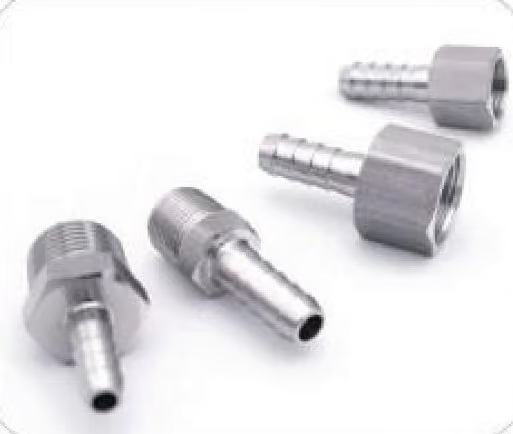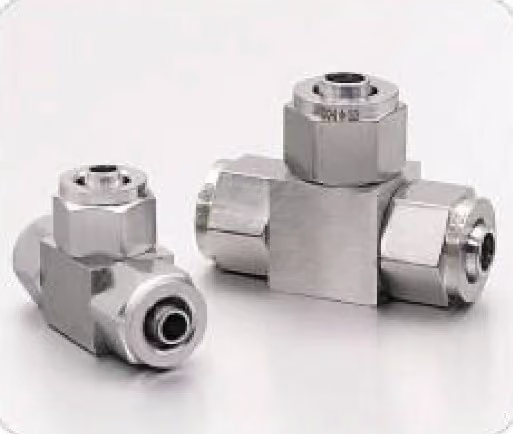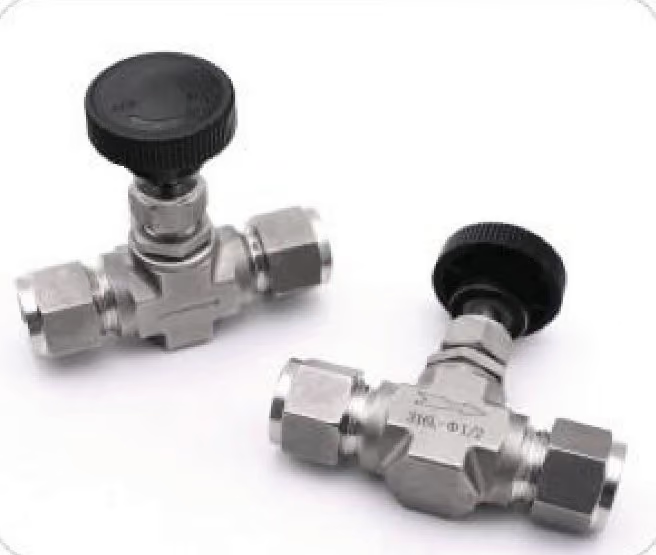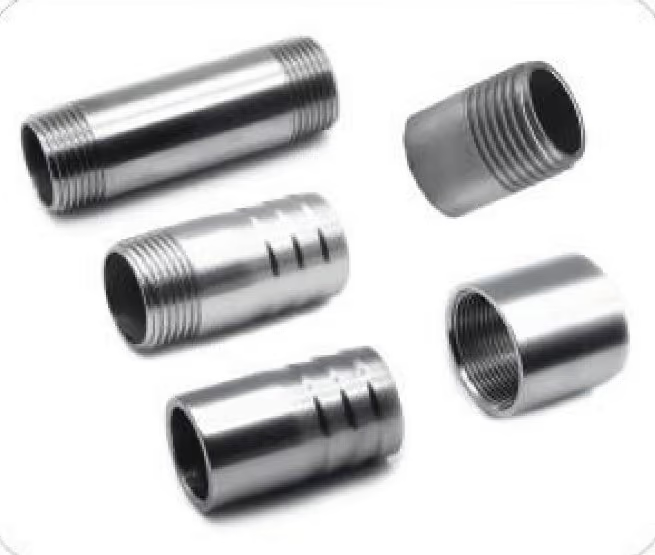
Investment cast fittings and machined fittings can deliver the same part number with the same pressure rating — and land on completely different cost curves. The cast elbow gets its complex shape essentially for free but carries tolerance and porosity baggage; the machined elbow holds beautiful tolerances on any geometry you can cut, one chip at a time, at a price that never stops being linear in metal removal. Knowing where each process wins decides whether your RFQ reads like a buying plan or a wish list.
Key takeaways
- Investment casting forms near-net shapes from a wax pattern: injected pattern, ceramic shell, dewax, pour, knockout — complex elbows, tees and valve bodies come out nearly finished.
- Machining from bar or forging holds the tight tolerances — CNC typically ±0.025 mm class — and the fine surface; investment casting runs ±0.1–0.5 mm and an as-cast surface around Ra 1.6–6.3 µm.
- Cost breaks at volume: investment casting tooling commonly pays back in the 100–500 piece range; below that, machining usually wins total cost.
- Cast pressure parts carry porosity risk — qualifying them means NDT and hydrostatic testing to the applicable valve/fitting test standards, with traceable heat numbers.
- Grades differ by process: cast stainless is CF8/CF8M (ASTM A351, the cast analogs of 304/316); free-machining 303 is a bar-stock grade, not a standard casting alloy.
How each is made
Investment casting builds the part backwards from its finish. Wax is injected into a metal die; wax patterns are assembled into a tree; the tree is dipped and stuccoed with ceramic slurry until a hard shell forms; the shell is dewaxed in steam autoclave or flash-fire; molten stainless is poured into the cavity; the shell is knocked off and the parts cut off the tree. What comes out is near-net-shape — a 90° elbow or a tee with its complex internal geometry already formed, needing only finishing and machining of the sealing faces. Machining starts from the other end: solid bar or a forging in a CNC lathe or mill, cutting the shape out of full-section stock. Every internal corner costs cutting time; every part pays it again.
Where casting wins
Complexity is free in wax but expensive in chips. Elbows with swept internal radii, tees, valve bodies and Y-patterns — geometries that would hog out half a bar billet — come out of the mold nearly complete. Tooling is real but modest — investment casting dies commonly run in the low thousands of dollars with break-even in the hundreds of pieces, against die casting’s far higher tooling and volume thresholds. Above roughly 500 pieces the per-part economics flip decisively; below about 100, machining almost always wins on total cost. The cast fittings range is built on this logic.
Where machining wins
Tolerances, surface and flexibility. CNC work holds ±0.025 mm class on critical features as a matter of routine, against investment casting’s ±0.1–0.5 mm linear tolerance band (ISO 8062 CT4–CT6 territory, size-dependent). Surfaces run finer too — as-machined Ra 0.4–1.6 µm class versus the as-cast 1.6–6.3 µm, which matters where seals land. And there is no tooling: prototypes and small lots skip the die entirely, free-machining grades like 303 cut fast from bar, and a drawing change is a program edit, not a new wax die. Non-standard and low-volume specials live here — that is the custom fittings territory.
Material access is the quieter advantage. The casting ecosystem standardizes on a handful of grades — CF8 and CF8M cover most industrial demand — while duplex and nickel alloys, though castable under separate specifications with tighter melt chemistry, heat treatment and small-heat premiums, are disproportionately expensive in small quantities. The same alloys sit on distributor shelves as bar: 2205 duplex, Inconel 625 and 718, Monel and the Hastelloy C-276 family are routine CNC materials. For a 20-piece run in a special alloy, the bar route is often the only practical route.
Schedule is the other edge. With no die to build, prototypes and small lots move in days — simple parts commonly 3–5 days standard — while casting mold setup alone runs weeks. One honesty note: specialty alloys machine slowly, so the bar route buys access and lead time, not cheap chips.
Porosity and pressure integrity
Cast metal can hide voids — shrinkage and gas porosity — that machining cannot see. Process references put cast strength potentially 10–30% below wrought stock of the same nominal grade, which is why pressure-retaining castings are qualified, not assumed: radiographic or ultrasonic examination for internal defects, dye-penetrant or magnetic-particle for surfaces, and hydrostatic shell and seat testing to the applicable standards (MSS SP-61, API 598, ISO 5208), with MSS SP-25 marking carrying the heat number for traceability. This is the same proof-versus-burst discipline covered in proof pressure vs burst pressure, and the certification trail in EN 10204 3.1 certificates is what makes a cast heat auditable.
RFQ lines
- Drawing plus annual quantity — the process decision rides on volume.
- Critical dimensions with tolerances — tell the factory which faces are sealing or gauging surfaces.
- Grade by process:
CF8Mfor cast 316-equivalent,316L barfor machined — name the form. - Test requirements: NDT level, hydrostatic test, certificate type.
- Surface callouts on wetted or sealing surfaces.
FAQ
When does investment casting beat machining on cost? Above roughly 100–500 pieces, where the modest die cost spreads thin; below about 100 pieces, machining almost always wins total cost. The crossover depends on complexity — the more chips a part would hog out, the earlier casting pays.
Which process holds tighter tolerances? Machining, by an order of magnitude on critical features: CNC routine tolerance around ±0.025 mm versus investment casting’s ±0.1–0.5 mm band. Specify which dimensions actually need the tight band — most of a fitting does not, and demanding CNC tolerance everywhere is how RFQs get expensive.
Is a cast fitting weaker than a machined one? Potentially, yes — internal porosity and cast grain structure can put cast strength 10–30% below wrought stock, which is exactly why pressure castings are qualified by NDT and hydrostatic test rather than trusted by grade name. A tested CF8M casting is a sound pressure part; an untested one is a question mark.
What do CF8 and CF8M mean? The ASTM A351 cast-grade designations: CF8 is the cast analog of 304, CF8M of 316. If the drawing says 316 and the part is cast, the correct material line is CF8M — same corrosion family, different specification route.
Can I get 303 in an investment casting? Not as a standard option. 303 is a free-machining wrought bar grade (sulfur-added for machinability); standard cast stainless grades are CF8/CF8M per ASTM A351. If the design assumed 303 machinability, the cast route needs a grade conversation first.